
The focus of the lesson: Animal body parts and present simple 3rd person singular
Size of the class: 40 students
Age: 11-12 years old/grade 6
Level: Elementary
Length of the lesson: 45 minutes
Once a year the school I teach for holds a demonstrative lesson for the Parents Committee, School’s teachers, and other guests. I was assigned for this lesson on a Saturday morning and I was asked to design a 30-45 minutes lesson.
I wanted a topic that has nothing in common with the topics from the school’s English course book. The animal body parts topic come through my mind in one evening when I was reading a story for my 5 year old daughter. The lesson is a comparison between human body parts and animal body parts.
The lesson starts with a simple crossword. The students have to find and circle some of the human body parts. The task’s purpose is to review the human body parts.

As usually, I have projected the picture on the board and I asked students to come to the board and solve the word search. Once the words were found I worked on pronunciation very briefly then I moved on to the body parts comparison.
Human body parts vs. Animal body parts
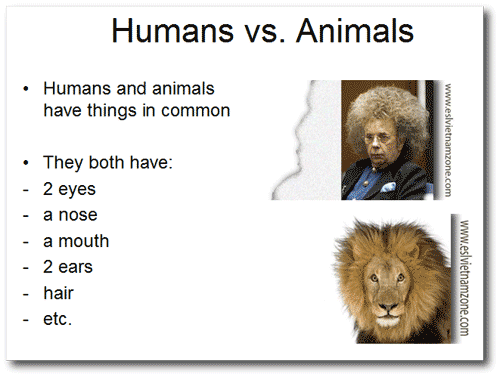
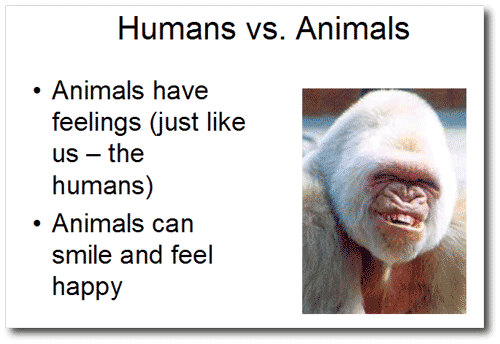
Explain to students that humans and animals have things in common. The first two slides of my presentation explain that. The teacher can assign a student to read the text from the presentation’s slide.
Next two slides point out that an animal doesn’t have teeth, hands etc.
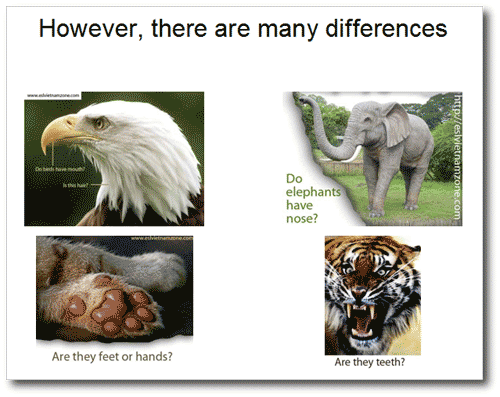
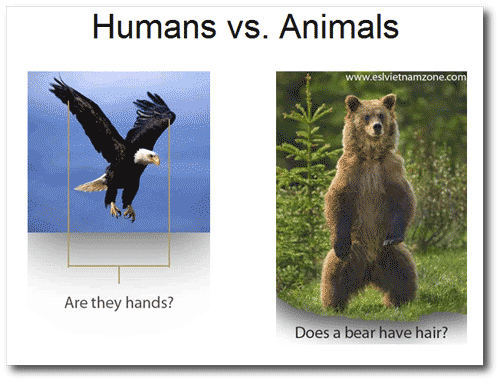
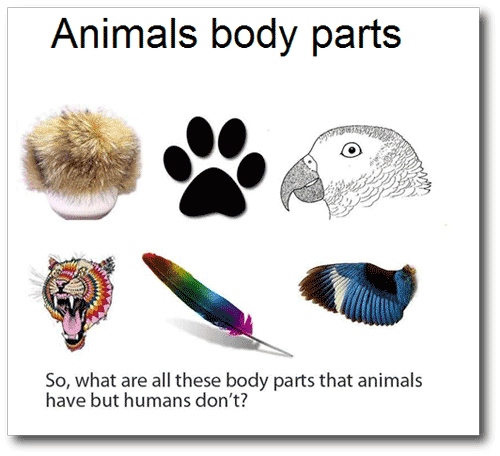
The next two slides of the presentation present animals body parts:
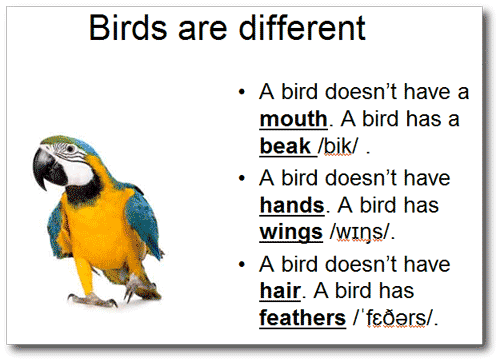
- A bird doesn’t have a mouth. A bird has a beak /bik/.
- A bird doesn’t have hands. A bird has wings /wɪŋs/.
- A bird doesn’t have hair. A bird has feathers /ˈfɛðərs/.
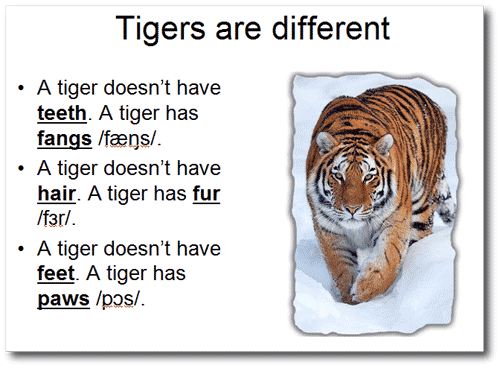
- A tiger doesn’t have teeth. A tiger has fangs /fæŋs/.
- A tiger doesn’t have hair. A tiger has fur /fɜr/.
- A tiger doesn’t have feet. A tiger has paws /pɔs/.
As a grammar point, the 3rd person singular present simple is introduced at this point. Usually, the Vietnamese English teacher explains the grammar point.
The next task for my students was a riddle. The riddle contains missing words that have to be completed in order to find the solution.
The riddle
Complete the missing words using 4 of the following words: hands, beak, fur, mouth, fangs, teeth, feet, paws, lion, parrot, and tiger.
The productive task (individual, pairs or small groups)
Students write a description of an animal using vocabulary learned in this lesson, the present simple tense, and the model provided.