
About dictation and few of its benefits
Dictation is considered a teacher-centered writing activity that doesn’t really develop writing skills. I definitely don’t believe that. How can be a teacher-centered activity?! Students have to listen carefully, understand, and then write down. It is a difficult activity that helps students developing listening skills (they have to listen and understand what teacher is saying during the dictation time), writing skills (well, it doesn’t help students developing creative writing, but it does help them developing spelling and punctuation.
Some people will say that listening word by word is useless. Dictation is not about listening word by word, is more about listening phrase by phrase. Dictation also involves grammar, vocabulary, and pronunciation. In conclusion, dictation helps developing all four language skills plus grammar, vocabulary, and punctuation.
For many learners of English, making difference between the sounds of English is quite challenging; dictation helps students to distinguish these sounds, which is very important in language acquisition. Bad behaviored students become quiet and focus their attention on listening; more than that, the teacher can review old material (such as vocabulary, grammar etc).
Dictation and Vietnamese learners of English
I have been teaching English for a Public School (State School) in Vietnam since 2011. It is a completely different experience if we compare it with teaching for one of the two hundred English Centers from Ho Chi Minh City. I have never tried dictation with my students from the English Centers I work for but I tried with my students from the Public School. They are grade 6 and grade 7 students and some of them are hard working students. Of course, some of them are totally uninterested in studying English.
I have prepared a simple text for dictation (same text for grade 6 and grade 7); a text that gives general information about a fictive person. I used very simple language that we studied already this school year. I have to mention that I have never checked their writing (spelling) abilities. All we did together was “ask and answer” activities and I have to say that they did a great job. Dictation is a new activity for them and because of the simplicity of the text; I was thinking there won’t be any problem. But, surprise!
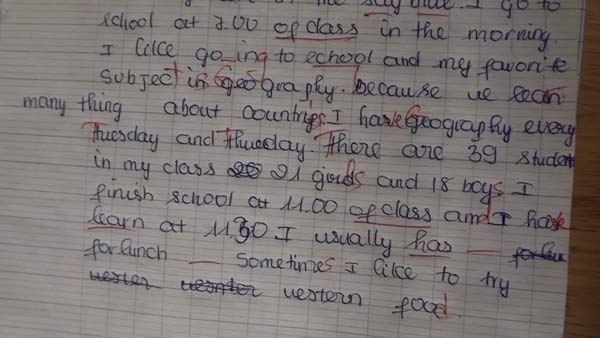
After a week of doing dictation with all of my classes, I was very surprised to realize that they don’t know how to spell simple (I mean very simple) English words. That is very strange because they fulfill one notebook every month with exercises and different other activities prepared by their Vietnamese teacher of English.
Below I present few of the mistakes that surprised me the most
- The word “motorbike” is well known in Vietnam. Everyone knows what the word “motorbike” means but they have no idea how it is spelled. Most of them have written “motoby” instead of “motorbike”. Why? Because everybody pronounces /motobɑɪ/, so it is spelled in the same way.
- Vietnamese have a big problem with numbers. When it comes to numbers, English is extremely difficult. “I am 35 years old and …” was the most difficult sentence in my dictation. Confusion between 13 (thirteen) and 30 (thirty) is made because of the last consonant sound that makes the difference. Pronouncing the last consonant sound is almost impossible for Vietnamese learners. I have found few good pronunciation activities (pair words activities) that can help but it takes time.
- A simple word like “house” is spelled “hau” because it is pronounced /hʌu/ by most of Vietnamese.
- “It” is another difficult word to be understood. This is hard for me to understand why because the Vietnamese language has this word and it is pronounced in the same way (example “một ít”). They pronounce “It is …” as “e e” (/ii/).
- For some reasons they do not use punctuation marks. It might be my fault!
- I knew about the last consonant sound problem but I didn’t know about the first consonant sound (“small” is spelled “mall”). They truly don’t hear the “s-” sound at the beginning of “small”, doesn’t matter how hard I try to pronounce it (as clear as possible, without making the word sound strange).
- “How many students are there in your class?” In this case the word “there” is very well understood but once I change the context, they can’t understand it any more. My sentence was “… and I get there by …” The same problem with the word “food”; the sentence “What is your favorite food?” is well understood but if I said “… Vietnamese food”, they understood “Vietnamese school”.
- The word “o’clock” is understood “a class”.
- It is still difficult to differentiate between country and nationality (Vietnamese vs.Vietnam).
- I have told them so many times that “teacher” is not “kitchen” and definitely it is not “chicken”.
The above mentioned are mistakes made by all of my students (grade 6 and 7), mistakes that I couldn’t believe they can occur. Somehow these problems have to be fixed.